
Category: Sin categoría
In March of 2017, Master Maitreya Samyaksambuddha, President of BUDDHIST TRIBUNAL ON HUMAN RIGHTS, has become member of the
Commission on Legal Pluralism
Institutional Membership in Association of Tribal Archives, Libraries and Museums
Institutional Membership in United Buddhist Nations Organization
Institutional Membership in Restorative Justice International
Institutional Membership in Human Rights Lawyers Association (HRLA)
Membership in Commission on Legal Pluralism
Endorsement to the International Monsanto Tribunal
Internal Regulations and Procedures
CONSTITUTIVE ACT
International Buddhist Ethics Committee (IBEC)
Buddhist Tribunal on Human Rights (BTHR)
BASED ON RESOLUTION No. 12 OF THE STEERING COMMITTEE OF THE SEVENTH BUDDHIST COUNCIL, THE PRESENT ACT GIVES FORMAL AND PROTOCOLLED BIRTH TO: INTERNATIONAL BUDDHIST ETHICS COMMITTEE & BUDDHIST TRIBUNAL ON HUMAN RIGHTS. ON THE BASIS OF THE DE CONSTITUTIVE ACT OF MARCH 1st, 2015 THE FOLLOWING STATUTES AND PROCEDURES ARE SUSTAINED AND UNDERPINNED AS JUDICIAL POWER OF MAITRIYANA BUDDHIST COMMUNITY.
Part I: STATUTES
ADDRESS:
ARTICLE 1.- The central office will be
- INTERNATIONAL BUDDHIST ETHICS COMMITTEE, Tiptrans Ste 19307, Unit 5 Atlas Road, Bootle, L20 4DY (Merseyside), United Kingdom
NATIONALITY
ARTICLE 2.- The Nationality of the INTERNATIONAL BUDDHIST ETHICS COMMITTEE & BUDDHIST TRIBUNAL ON HUMAN RIGHTS, will be “Transnational”, by establishing that its members shall have diversity in terms of nationalities.
DURATION
ARTICLE 3.- The Duration of the INTERNATIONAL BUDDHIST ETHICS COMMITTEE & BUDDHIST TRIBUNAL ON HUMAN RIGHTS will be “Indefinite” or “Perennial” as from the celebration of this Constitutive Act.
OBJECT
ARTICLE 4.- The object of INTERNATIONAL BUDDHIST ETHICS COMMITTEE & BUDDHIST TRIBUNAL OF HUMAN RIGHTS lists the following functions and activities:
- a) To analyze cases of violations on Buddhist Ethics perpetrated by Buddhist or apparently Buddhist People or institutions, dictating Responsibility or Innocence of them.
- b) To analyze cases of violations against the rights of Buddhist People around the world, dictating the Responsibility or Innocence of the Accused.
- c) To analyze cases of Human Rights violations perpetrated by countries, companies or international organizations committed to the detriment of all kinds of Persons, including attacks against the integrity of Animal Species, Ecosystems and the Earth (Gaia), dictating the Responsibility or Innocence of them.
ARTICLE 5.- It will be custom of the Ethics Committee analyzing the cases of violations by individuals and Institutions against Buddhism, while the Tribunal of Human Rights will examine the violations committed by corporations and governments against civil population.
ARTICLE 6.- The INTERNATIONAL BUDDHIST ETHICS COMMITTEE seeks the fulfillment of the Buddhist precepts, prioritizing study the study of violations of basic ethical rules of Buddhism, such as acts of violence, fraud, sexual abuse, slander and drug abuse by Buddhist and spiritual movements.
ARTICLE 7.- The BUDDHIST TRIBUNAL OF HUMAN RIGHTS complies with the bodhisattva vows, assuming the project of salvation of all living beings, fighting the illusions of civilization, acquiring the straightness of the Supreme Laws and realizing the path of the Awakened Ones (Buddhas).
ARTICLE 8.- In cases of Human Rights violations, it will be given priority to international crimes of Genocide, Ethnic Cleansing, Crimes against Humanity, War Crimes, Ecocide and Crimes against Peace, which threaten the peace and well-being of Buddhist Peoples and all humanity.
ARTICLE 9.- It is also considered as International Crimes the violation of animal rights, terrorism, violation of the right to freedom of expression, violation of the rights of tribal peoples, human trafficking, drug trafficking, corruption, religious discrimination, torture, violation of the right to justice, fascism, illegal detention, violation of the rights of women and children, crimes against peace, the use of religious emblems to commit crimes, and the violation of the principles of international organizations.
ARTICLE 10.- The International Buddhist Ethics Committee & Buddhist Tribunal on Human Rights has different functions: Teaching function, Advisory function, Normative function, Mediating function and Sanctioning function. The Educational Function, which is the most important and primordial, can be carried out in three levels: internal (directed to the members of the Committee), external (directed to Buddhist People) and social (when a certain judgment of the Committee transcends outside the Buddhist scope and it has an effect on the international community).
IMPRESCRIPTIBILITY
ARTICLE 11.- It will be a priority the analysis of cases occurred in the XXI Century. However, cases that are previous to XXI century will also be examined provided that those accused are alive, since they have the right to defense. This means the recognition of the imprescriptibility of violations against Buddhist Ethics and Human Rights.
INTEGRATION
ARTICLE 12.- The composition of the INTERNATIONAL BUDDHIST ETHICS COMMITTEE & BUDDHIST TRIBUNAL ON HUMAN RIGHTS shall be composed of Representatives of the following Communities, Schools, Institutions and International Organizations of Buddhism, which are constituted as Institutional Members of the Committee and Tribunal:
- Indian Buddhist Federation
- Zen Multiversity
- International Association of Buddhist Socialism
- World Association of Theravada
- Amitabha Buddhist Society
- Institute of Buddhist Psychoanalysis & Zen-Analysis
- Buddha Bhoomi Foundation
- Bo´tree News
- Integrated Development Society
- Super-Integral Institute
- Buddha Research Foundation
- Institute of Contemporary Buddhist Science
- College of International Buddhist Law
- Institute of Buddhist Christianity
- Buddhist Voice E-magazine
- Reiyukai Welfare Association Bangladesh
BOARD OF ADMINISTRATION
ARTICLE 13.- The Board of Administration of the INTERNATIONAL BUDDHIST ETHICS COMMITTEE & BUDDHIST TRIBUNAL ON HUMAN RIGHTS is formed based on the following ORGANIZATIONAL CHART:
- PRESIDENT and ETHICS JUDGE (Vinayadhara): Is that who shall have the faculty to advocate for the appropriate functioning of the Committee and Tribunal, by providing ethical guidance to the Prosecutor during the stage of procedure, by validating charges, evidences and procedures. In addition, he or she shall have to exert Presidency during the stage of Judgment and Ethical Conclusion in the Case. For this position it is required to be Master of Buddhist Spirituality as well as having formal knowledge in International Law.
- PROSECUTOR: That who shall have the faculties to investigate and prosecute People, Institutions or Countries accused of committing violations against Buddhist Spirituality or Human Rights, by bringing evidences of the case to the Human Rights Defenders. For this position it is an imperative requirement not only to have and Academic Training in Law or Human Rights, but also to have Buddhism studies.
- HUMAN RIGHTS DEFENDER: Is that who will have the faculty of evaluate and declare on the status of “just” or “unjust” regarding the Prosecutor accusation.
- PEACE AMBASSADOR: Is that who will have the faculty to share a message the peace on behalf the Committee and Tribunal around the world. Who shall have the faculty to being able to impugn charges against the accused party, and also will have the faculty to establish institutional ties with other international organizations.
DURATION OF POSITIONS
ARTICLE 14- The 4 positions of the Board of Directors will last forever, being able to be replaced only when there is no participation.
ADMISSION, EXCLUSION AND SEPARATION OF MEMBERS
ARTICLE 15.- Those who aspire to become individual members will be able to be a part of the Committee and Tribunal as Members with the approval of 60% of positive votes of the Board of Administration.
ARTICLE 16.- To be a Member, the candidate must meet the following requirements: Being a Buddhist, Represent a Buddhist Organization and having appropriate behavior.
ARTICLE 17.- In some cases the figure of the Friend of the Court (Amicurs Curiae) will be allowed for participation, who could may bring charges or defenses inside the Committee and the Tribunal.
ARTICLE 18.- Members must have signed a solemn pledge to respect the values of the Buddha-Dharma-Sangha.
ARTICLE 19.- The Committee and Tribunal may exclude temporarily or permanently those Members who violate the Internal Regulations and Procedures; who commit violations to Buddhist ethics; or those who fail to comply with their functions, this being a decision that will be taken with 60% of positive votes of the Board of Directors.
RIGHTS
ARTICLE 20.- The INTERNATIONAL BUDDHIST ETHICS COMMITTEE & BUDDHIST TRIBUNAL ON HUMAN RIGHTS reserves the rights concerning Title, Name, Patent, Copyright, Management, Paperwork, Procedures and everything that will be done in the performance of their functions.
CONTRIBUTIONS
ARTICLE 21.- The INTERNATIONAL BUDDHIST ETHICS COMMITTEE & BUDDHIST TRIBUNAL ON HUMAN RIGHTS will not charge fees, face of which will offer free Memberships. However, it will be open to receive donations or sponsors; contributions of its institutional members and organization of courses, which will be destined to cover the costs of maintenance of Headquarters, administrative procedures and costs of investigation of cases.
MEETINGS AND SESSIONS
ARTICLE 22.- The meetings of the INTERNATIONAL BUDDHIST ETHICS COMMITTEE & BUDDHIST TRIBUNAL ON HUMAN RIGHTS will be held in person and / or by using digital media such as Internet and its applications, always having the supreme responsibility to be faithful to the Truth.
UPDATING STATUTES
ARTICLE 23.- The statutes and procedures may frequently be updated from five legal sources: the ancient legal code (Vinaya) of the Buddhist people; the laws enacted by the Buddhas of history; the laws enacted by the current board of the Committee and Tribunal; the laws enacted by the President and Spiritual Judge; the laws of International Law and the human rights instruments. The authority of these updatings should shall always be investigated and confirmed, being adopted only if they are in conformity with the spirit existing in the Buddha-Dharma-Sangha.
ARTICLE 24.- Statutory changes of procedures shall not invalidate previous cases’ actions carried out by the Committee and Tribunal.
Part II: JURISDICTION
ARTICLE 25.- The present Procedure of the INTERNATIONAL BUDDHIST ETHICS COMMITTEE & BUDDHIST TRIBUNAL ON HUMAN RIGHTS is not regulated by any state authority, being a process of ethical and spiritual nature which continues with the ancient justice system of the Buddhist Law. Nevertheless, the procedure is legal because it relies on the “special jurisdiction” of Tribal Law, but also in the “universal jurisdiction” of International Law. Thus, the Committee and Tribunal have the right to promote, develop and maintain the institutional structures of Buddhist people and their distinctive customs, traditions, procedures and juridical practices, simultaneously adhering to internationally recognized standards such as Declarations, Covenants and International Conventions on Human Rights, especially emphasizing the “169th Convention of the International Labour Organization (ILO) on Indigenous and Tribal Peoples” of 1989, along with the “UN Declaration on the Rights of Indigenous Peoples” of 2007, and the American Declaration on the Rights of Indigenous Peoples of 2016.
ARTICLE 26.- The INTERNATIONAL BUDDHIST ETHICS COMMITTEE & BUDDHIST TRIBUNAL ON HUMAN RIGHTS is protected by formal instruments of the International Law of Human Rights, like the “United Nations Declaration on the Rights of Indigenous Peoples”, which said: “Article 5. Indigenous peoples have the right to maintain and strengthen their distinct political, legal, economic, social and cultural institutions, while retaining their right to participate fully, if they so choose, in the political, economic, social and cultural life of the State. (…) Article 34. Indigenous peoples have the right to promote, develop and maintain their institutional structures and their distinctive customs, spirituality, traditions, procedures, practices and, in the cases where they exist, juridical systems or customs, in accordance with international human rights standards. (…) Article 40. Indigenous peoples have the right to access to and prompt decision through just and fair procedures for the resolution of conflicts and disputes with States or other parties, as well as to effective remedies for all infringements of their individual and collective rights. Such a decision shall give due consideration to the customs, traditions, rules and legal systems of the indigenous peoples concerned and international human rights.” Also, the AMERICAN DECLARATION ON THE RIGHTS OF INDIGENOUS PEOPLES said: Article VI. Indigenous peoples have collective rights that are indispensable for their existence, well-being, and integral development as peoples. In that regard, States recognize and respect the right of indigenous peoples to their collective action; to their juridical, social, political, and economic systems or institutions; to their own cultures; to profess and practice their spiritual beliefs; to use their own tongues and languages; and to their lands, territories and resources. States shall promote, with the full and effective participation of indigenous peoples, the harmonious coexistence of the rights and systems of different population groups and cultures. Article XXII. 1. Indigenous peoples have the right to promote, develop and maintain their institutional structures and their distinctive customs, spirituality, traditions, procedures, practices and, in the cases where they exist, juridical systems or customs, in accordance with international human rights standards. 2. Indigenous law and legal systems shall be recognized and respected by national, regional and international legal systems.
ARTICLE 27.- The INTERNATIONAL BUDDHIST ETHICS COMMITTEE & BUDDHIST TRIBUNAL ON HUMAN RIGHTS is protected by formal instruments of the International Law of Human Rights, like the “Santiago Declaration on the Human Right to Peace”, which said: “Article 11. Rights of all victims (…) Every victim of a human rights violation has the right, in accordance with international human rights law, to the restoration of the violated rights; to obtain effective and complete redress, including the right to rehabilitation and compensation; measures of symbolic redress or reparation as well as guarantees that the violation Will not be repeated. Such redress shall not preclude recourse to popular courts or tribunals of conscience and to institutions, methods, traditions or local customs of peaceful settlement of disputes, which may be acceptable to the victim as adequate reparation.”
ARTICLE 28.- The INTERNATIONAL BUDDHIST ETHICS COMMITTEE & BUDDHIST TRIBUNAL ON HUMAN RIGHTS is endorsing the Universal Declaration of Spiritual Rights, the Universal Declaration of Ecological Rights, the Universal Declaration on the Right to World Peace, the Universal Declaration on the Rights of Buddhist Peoples and Spiritual Communities, the Universal Declaration on the Rights of Non-Human Beings, the Universal Declaration on the Right to Interspiritual and Interfaith Harmony, the Universal Declaration on the Responsibility to Save the World, the Declaration of Independence of the United Buddhist Nations Organization, the Universal Declaration on Buddhism as Cultural Heritage of Humanity, the Buddhist Manifesto to the Nations of the World, the Buddhist Statement against Terrorism and Religious Manipulation, and the Buddhist Convention on Human Rights.
ARTICLE 29.- The INTERNATIONAL BUDDHIST ETHICS COMMITTEE & BUDDHIST TRIBUNAL ON HUMAN RIGHTS is endorsing the Earth Charter.
ARTICLE 30.- The INTERNATIONAL BUDDHIST ETHICS COMMITTEE & BUDDHIST TRIBUNAL ON HUMAN RIGHTS is registered as Institutional Member of ATALM Association of Tribal Archives, Libraries, and Museums.
ARTICLE 31.- The INTERNATIONAL BUDDHIST ETHICS COMMITTEE & BUDDHIST TRIBUNAL ON HUMAN RIGHTS is fully autonomous and established for the sole purpose to know, decide and dictate about actions and omissions in the universal practice of Buddhist Ethics and Human Rights. Unlike the Administration of State Law and Punitive Justice, dedicated to the deprivation of liberty and monetary sanction, the Committee and Tribunal shall be referred to determine the ethical and humanitarian responsibility for the action committed by the Accused, by having the Purpose of the Human Right to Truth, Access to Justice, Reparation, Reconciliation and Learning.
ARTICLE 32.- The INTERNATIONAL BUDDHIST ETHICS COMMITTEE & BUDDHIST TRIBUNAL ON HUMAN RIGHTS is Founding Institutional Member of United Buddhist Nations Organization, with Registration Number A012017.
ARTICLE 33.- The INTERNATIONAL BUDDHIST ETHICS COMMITTEE & BUDDHIST TRIBUNAL ON HUMAN RIGHTS inherits the ancient Buddhist Tribal Law procedures, but also belongs to the contemporary paradigm of restorative justice.
ARTICLE 34.- The INTERNATIONAL BUDDHIST ETHICS COMMITTEE & BUDDHIST TRIBUNAL ON HUMAN RIGHTS is registered as Institutional Member of RESTORATIVE JUSTICE INTERNATIONAL.
ARTICLE 35.- The INTERNATIONAL BUDDHIST ETHICS COMMITTEE & BUDDHIST TRIBUNAL ON HUMAN RIGHTS wins immunity for being a tribal court of the Buddhist people. However, this tribal sovereign immunity for the organization and its board members is limited in cases of international crimes. Such immunity by the members of the Committee and the Court does not mean impunity, since it is offering to any victim or claimant certain internal dispute resolution procedures, ensuring respect for the human right to access to justice. The same criteria used by the Committee and Tribunal to win non-absolute sovereign immunity is applied when analyzing violations of human rights committed by States, which before the Buddhist Justice have no sovereign immunity for international crimes of genocide, ethnic cleansing, crimes against humanity, war crimes and ecocide.
ARTICLE 36.- The INTERNATIONAL BUDDHIST ETHICS COMMITTEE & BUDDHIST TRIBUNAL ON HUMAN RIGHTS aims to repair both ethical failures as well as legal and bureaucratic failures that international courts and tribunals of justice have, especially in cases where the Perennial Law (Jus cogens) or Essential Human Rights are violated under the pretext of immunity which provides impunity to the States accused of international crimes.
ARTICLE 37.- The INTERNATIONAL BUDDHIST ETHICS COMMITTEE & BUDDHIST TRIBUNAL ON HUMAN RIGHTS will judge in Equity with the Purpose of repaid injustices derived from procedures in Law.
ARTICLE 38.- The INTERNATIONAL BUDDHIST ETHICS COMMITTEE & BUDDHIST TRIBUNAL ON HUMAN RIGHTS is registered as Institutional Member of HUMAN RIGHTS LAWYERS ASSOCIATION.
ARTICLE 39.- The INTERNATIONAL BUDDHIST ETHICS COMMITTEE & BUDDHIST TRIBUNAL ON HUMAN RIGHTS has absolute jurisdiction on members of the Buddhist People, and also jurisdiction on those who are directly or indirectly related with the Sangha, even if they are not signatories of the framework of Buddhist Law.
Part III: STAGES OF PROCEDURE
ARTICLE 40.- The INTERNATIONAL BUDDHIST ETHICS COMMITTEE & BUDDHIST TRIBUNAL ON HUMAN RIGHTS respect the four essential stages of due process, such as indictment, defense, evidence and judgment. International guarantees such as the right to presumption of innocence, the right not to self-incriminate, the right to remain silent, the right to information, the right to defense, the right to a public trial, the right to probation, the right to declare freely, the right to certainty and the right to res judicata are also respected. The stages of Procedure of the Committee and Tribunal, which are based on the functions entrusted to them, are established below:
FIRST STAGE “RECEPTION OF THE CASE”
ARTICLE 41.- The INTERNATIONAL BUDDHIST ETHICS COMMITTE & BUDDHIST TRIBUNAL ON HUMAN RIGHTS will receive cases submitted by Buddhist institutions, organizations and citizens around the world. Facing a case that is submitted only by an individual, he or she should be endorsed by any institution Member of the Committee. On the basis of Buddhist Ethics and the Human Rights, it will be analyzed the admissibility or inadmissibility of the reception and opening of the case. The Committee and Tribunal will be in session after collecting sufficient, concrete and concise Evidence about the cases presented.
SECOND STAGE “RECEPTION AND INVESTIGATION OF EVIDENCES”
ARTICLE 42.- The Prosecutor will collect the Evidence on the possible case of violation of Buddhist ethics or Human Rights. These evidences will come both from the Claimant or Offended Party and from the investigations of the INTERNATIONAL BUDDHIST ETHICS COMMITTEE & BUDDHIST TRIBUNAL ON HUMAN RIGHTS. Evidences will be analyzed by the Prosecutor, who will decide if the case merits the Procedure of “Ethical Judgment”.
ARTICLE 43.- In the context of its own investigations, the Prosecutor may request evidence from organizations or States.
THIRD STAGE “RESPONSE”
ARTICLE 44.- The INTERNATIONAL BUDDHIST ETHICS COMMITTEE & BUDDHIST TRIBUNAL ON HUMAN RIGHTS will provide the opportunity to the Imputed or Requested Party in order that in the term of 5 working days issues a Response of what it considers as a defense or accepts and adheres to the facts alleged against said Party in the Indictment and may justify their actions or present evidence of his innocence. The omission or refusal to issue Response and / or provision of evidence will not be considered as acceptance of the facts, acts or omissions that are imputed, but neither will be stopped the subsequent legal procedures of the Ethical Judgment and Sentence, which will be carried out in the “absence” of accused provided that he/she/it does not make his/her/its statement. It is important that if the defendant intends to question the competence of the Committee and the Tribunal, he or she should state it during the “Response” stage of the accusation, since if he or she does not do so, it will be understood that it has consented to the Ethical Trial.
ARTICLE 45.- In case the Required or Accused party offers sincere public apology for what was done, and as far as possible amends his/her/its fault or violation to the Buddhist ethics way or human rights, in such cases the accused shall apologize publicly and formally, simultaneously performing acts designed to amend their offenses. In these cases the Committee and Tribunal agree on a “Peaceful and Reconciliatory Resolution”, with no need for the voting of the Human Rights Defenders and the President’s Sentence. However, if there is a repeated infringement, such “Peaceful Conciliatory Agreement” would have been violated, situation in which the subsequent Ethical Judgment would be immediately held.
ARTICLE 46.- The Accused shall have the right to its own lawyer or legal representation before the Committee and Tribunal. The above mentioned Legal Defender shall speak in defense of the accused, being able to recommend accepting responsibility or reaching a conciliatory resolution, by being able to impugn charges or evidences, or being able to present proof regarding the innocence of his/her represented party, situation in which the President shall decide about its admissibility.
FOURTH STAGE “ETHICAL JUDGMENT”
ARTICLE 47.- Following the stage of Response by the Imputed Party, and after having been received the validation of charges and evidences by the President, it will be given beginning to the “Ethical Judgment” by the Prosecutor before the Human Rights Defenders composed by Buddhist persons acting on behalf of Buddhist institutions and communities. In such presentation the evidences will be corroborated to the alleged case of violation to Buddhist ethics or human rights, by being validly accepted face-to-face and non-contact eyewitness testimonies coming from honorable people of an irreproachable conduct; physical and digital documentaries; Editorial and internet publications; emails, audios and videos; correspondence of postal service and other resources that constitute sufficient proof or complaint in urging Procedure.
FIFTH STAGE “LEGAL ANALYSIS”
ARTICLE 48.- Faced with Evidences submitted, the Human Rights Defenders of the INTERNATIONAL BUDDHIST ETHICS COMMITTEE & BUDDHIST TRIBUNAL ON HUMAN RIGHTS shall issue an opinion about the Prosecutor accusation, declaring it as “Just” or “Unjust” in the Buddhist Ethics and Human Rights arena. The vote of “Abstention” would also be permitted, although after 2 consecutive abstentions it shall be considered effective the resignation of the Human Rights Defender. The Human Rights Defender will issue an Opinion in the term of 5 five working days.
ARTICLE 49.- The accused will be declared responsible when has been demonstrated Responsibility beyond any reasonable doubt.
ARTICLE 50.- Where Human Rights Defenders votes are tied, the President may call to the Substitute Defenders in order to define the votation.
ARTICLE 51.- Members of Committee and Tribunal may request license periods through previous notice in order to attend trips or meditation retreats, or to deal with health issues. Such licenses may not be requested once they have received a case, in whose situation their absence will be considered as an Abstention.
ARTICLE 52.- The President may declare the vote of a Human Rights Defender as “Null”. This may occur when the member voting with reasons that violate Buddhist Law, Human Rights or Jurisprudence of the Committee and Tribunal.
SIXTH STAGE “ETHICAL JUDGMENT”
ARTICLE 53.- After the opinion performed by the Human Rights Defender, the President and Judge of the Committee and Tribunal will make an Ethical Statement as a teaching and a final conclusion on the case.
ARTICLE 54.- In the Ethical Judgment made by the President, a repair, restitution, indemnification or rehabilitation that benefits the victims may be requested.
ARTICLE 55.- In certain cases, the President may issue Acts, Notifications, Legal Opinions and Resolutions about the Judgment to third parties involved or related to the case. Those same post-sentence procedures can be sent to the Human Rights Defenders before an eventual expansion of charges in cases that violations of the Ethics or Human Rights are getting worse by the Accused after being issued a first Judgment.
ARTICLE 56.- In cases where the defendants appeal the Judgment, the case must be analyzed by the Supreme Buddhist Court of Justice, which will decide whether the judgment is valid or void.
Part IV: ADDITIONAL FUNCTIONS
ARTICLE 57.- The President of the Committee and Tribunal also has the function of establishing projects for dialogue with countries and international organizations in order to transmit the values of Buddhist Law throughout the world.
ARTICLE 58.- The INTERNATIONAL BUDDHIST ETHICS COMMITTEE & BUDDHIST TRIBUNAL ON HUMAN RIGHTS delivers distinctions, honors and awards to individuals, organizations and governments that stand out by their actions for Peace and Justice.
ARTICLE 59.- The INTERNATIONAL BUDDHIST ETHICS COMMITTEE & BUDDHIST TRIBUNAL ON HUMAN RIGHTS challenges and invalidates all spiritual degree to Buddhist Masters that has been issued by any government, especially in cases of governments violating human rights.
ARTICLE 60.- The INTERNATIONAL BUDDHIST ETHICS COMMITTEE & BUDDHIST TRIBUNAL ON HUMAN RIGHTS may challenge and invalidate prizes awarded to individuals, after having demonstrated the spurious nature of such awards.
ARTICLE 61.- The INTERNATIONAL BUDDHIST ETHICS COMMITTEE & BUDDHIST TRIBUNAL ON HUMAN RIGHTS may exercise “control of constitutionality and conventionality”, ethically overseeing that States do not violate their national Constitutions or violate the Conventions, Treaties, Covenants and Declarations which they have signed at international level. The validity of this ethical supervision or control will be provided by the fact that the Committee and Tribunal include within its Statute the commitment to the fulfillment of the following Human Rights instruments:
- Universal Declaration of Human Rights
- 1948 American Declaration of the Rights and Duties of Man
- Convention on the Prevention and Punishment of the Crime of Genocide
- Freedom of Association and Protection of the Right to Organise Convention
- Inter-American Convention on the Granting of Civil Rights to Women
- Convention for the Suppression of the Traffic in Persons and of the Exploitation of the Prostitution of Others
- Convention relative to the Protection of Civilian Persons in Time of War
- Convention relative to the Treatment of Prisoners of War
- Protection of wages Convention
- Right to Organise and Collective Bargaining Convention
- Convention for the Protection of Human Rights and Fundamental Freedoms
- Convention and protocol relating to the status of refugees
- Equal Remuneration Convention
- Convention on Minimum Standards of Social Security
- Universal Copyright Convention, with Appendix Declaration relating to Articles XVII and Resolution concerning Article XI
- Convention on the Political Rights of Women
- Convention relating to the Status of Stateless Persons
- Standard Minimum Rules for the Treatment of Prisoners
- Supplementary Convention on the Abolition of Slavery, the Slave Trade, and Institutions and Practices Similar to Slavery
- Abolition of Forced Labour Convention
- Discrimination Employment and Occupation Convention
- Declaration on the Granting of Independence to Colonial Countries and Peoples
- Convention against Discrimination in Education
- Convention on the reduction of statelessness
- European Social Charter
- Convention concerning Equality of Treatment of Nationals and Non-Nationals in Social Security
- Convention on Consent to Marriage, Minimum Age for Marriage and Registration of Marriages
- Convention concerning benefits in the case of employment injury
- Employment Policy Convention
- Declaration on the Promotion among Youth of the Ideals of Peace, Mutual Respect and Understanding between Peoples
- International Convention on the Elimination of All Forms of Racial Discrimination
- International Covenant on Civil and Political Rights
- International Covenant on Economic, Social and Cultural Rights
- Declaration on the Elimination of Discrimination against Women
- Recommendation concerning Invalidity, Old-Age and Survivors’ Benefits
- Convention on the Non-Applicability of Statutory Limitations to War Crimes and crimes against humanity
- AMERICAN CONVENTION ON HUMAN RIGHTS – Pact of San Jose Costa Rica
- Convention concerning Medical Care and Sickness Benefits
- Declaration of principles for international humanitarian relief to the civilian population in disaster situations
- Declaration on Social Progress and Development
- Convention concerning Minimum Wage Fixing, with Special Reference to Developing
- Declaration on Principles of International Law concerning friendly relations and co-operation among states in accordance with the charter of United Nations
- Declaration of the Indian Ocean as a Zone of Peace
- Declaration on the Rights of Mentally Retarded Persons
- Universal Copyright Convention
- Convention Concerning the Protection of the World Cultural and Natural Heritage
- Declaration of the United Nations Conference on the Human Environment
- Convention on International Trade in Endangered Species of Wild Fauna and Flora
- International Convention on the Suppression and Punishment of the Crime of Apartheid
- Minimum Age Convention
- Principles of cooperation
- Universal Declaration on the Eradication of Hunger and Malnutrition
- Declaration on the Protection of All Persons from Being Subjected to Torture
- Declaration on the Rights of Disabled Persons
- Declaration on the Use of Scientific and Technological Progress in the Interests of Peace and for the Benefit of Mankind
- Convention on the Prohibition of Military or Any Other Hostile Use of Environmental Modification Techniques
- Protocol Additional to the Geneva Conventions of 12 August 1949, and relating to the Protection of Victims of International Armed Conflicts (Protocol I)
- Protocol Additional to the Geneva Conventions of 12 August 1949, and relating to the Protection of Victims of Non-International Armed Conflicts (Protocol II)
- Declaration on Race and Racial Prejudice
- Declaration on the Preparation of Societies for Life in Peace
- Code of Conduct for Law Enforcement Officials
- Convention on the Elimination of All Forms of Discrimination against Women
- International Agreement for the Establishment of the University for Peace and Charter of the University for Peace
- African Charter on Human and Peoples Rights
- Declaration on the Elimination of All Forms of Intolerance and of Discrimination Based on Religion or Belief
- Declaration on the Participation of Women in Promoting International Peace and Cooperation
- Manila Declaration on the Peaceful Settlement of International Disputes
- World Charter for Nature
- Convention against Torture and Other Cruel, Inhuman or Degrading Treatment or Punishment
- Declaration on the Right of Peoples to Peace
- Safeguards guaranteeing protection of the rights of those facing the death penalty
- Basic Principles on the Independence of the Judiciary
- Declaration of Basic Principles of Justice for Victims of Crime and Abuse of Power
- Declaration on the Human Rights of Individuals Who are not Nationals of the Country in which They Live
- United Nations Standard Minimum Rules for the Administration of Juvenile Justice
- Vienna Convention for the Protection of the Ozone Layer
- Inter-American Convention to Prevent and Punish Torture
- Declaration on Social and Legal Principles relating to the Protection and Welfare of Children
- Declaration on the Right to Development
- Declaration on the Enhancement of the Effectiveness of the Principle of Refraining from the Threat or Use of Force in International Relations
- Additional Protocol to the American Convention on Human Rights in the Area of Economic, Social and Cultural Rights (Protocol of San Salvador)
- Body of Principles for the Protection of All Persons under Any Form of Detention or Imprisonment
- Convention concerning Employment Promotion and Protection against Unemployment
- Declaration on the Prevention and Removal of Disputes and Situations Which May Threaten International Peace and Security
- Community Charter of Fundamental Social Rights of Workers
- Convention concerning Indigenous and Tribal Peoples in Independent Countries
- Convention on the Rights of the Child
- Principles on the Effective Prevention and Investigation of Extra-legal, Arbitrary and Summary Executions
- Basic Principles on the Use of Force and Firearms by Law Enforcement Officials
- UN Basic Principles on the Role of Lawyers
- United Nations Guidelines for the Prevention of Juvenile Delinquency
- World Declaration on Education for All
- Basic Principles for the Treatment of Prisoners
- International Convention on the Protection of the Rights of All Migrant Workers and Members of Their Families
- United Nations Rules for the Protection of Juveniles Deprived of their Liberty
- United Nations Standard Minimum Rules for Non-custodial Measures
- Declaration on Fact-finding by the United Nations in the Field of the Maintenance of International Peace and Security
- UN Resolution on protection of persons with mental illness
- Convention on Biological diversity
- Declaration on the Protection of All Persons from Enforced Disappearance
- Declaration on the Rights of Persons Belonging to National or Ethnic, Religious and Linguistic Minorities
- The United Nations Framework Convention on Climate Change
- United Nations Conference on Environment & Development
- CONVENTION ON PROTECTION OF CHILDREN AND CO-OPERATION IN RESPECT OF INTERCOUNTRY ADOPTION
- Declaration on the Elimination of Violence against Women
- National institutions for the promotion and protection of human rights
- Declaration on the Enhancement of Cooperation between the United Nations and Regional Arrangements or Agencies in the Maintenance on international peace
- Inter-American Convention on the Prevention, Punishment and. Eradication of Violence against Women
- Standard Rules on the Equalization of Opportunities for Persons with Disabilities
- United Nations Conventions to Combat Desertification
- Declaration and Integrated Framework of Action on Education for Peace, Human Rights and Democracy
- Declaration of Principles on Tolerance
- Declaration of Principles of International Cultural Co-operation
- European Social Charter (revised)
- INTER-AMERICAN CONVENTION AGAINST CORRUPTION
- Universal Declaration on Linguistic Rights
- Sofia Declaration
- Agenda for Development
- Declaration on the Responsibilities of the Present Generations Towards Future Generations
- Kyoto Protocol to the UN Framework Convention on Climate Change
- Universal Declaration on the Human Genome and Human Rights
- 1998 Latin-American Declaration on Water
- Convention on Access to Information, Public Participation in Decision-Making and Access to Justice in Environmental Matters
- Declaration on the Right and Responsibility of Individuals, Groups and Organs of Society to Promote and Protect Universally Recognized Human Rights and Fundamental Freedoms
- ILO Declaration on Fundamental Principles and Rights at Work and its Follow-up
- Rome Statute of the International Criminal Court
- World Declaration on Higher Education for the Twenty-first Century
- Declaration and Programme of Action on a Culture of Peace
- Declaration and state of progress and initiatives for the future implementation of the Programme of Action for the Sustainable Development of Small Island Developing States
- Inter American convention on the elimination of all forms of discrimination against persons with disabilities
- The Hague Agenda for Peace and Justice for the 21 century
- Worst Forms of Child Labour Convention
- Principles on the Effective Investigation and Documentation of Torture
- CHARTER OF FUNDAMENTAL RIGHTS OF THE EUROPEAN UNION
- DECLARATION OF PRINCIPLES ON FREEDOM OF EXPRESSION
- Protocol to Prevent, Suppress and Punish Trafficking in Persons, Especially Women and Children, supplementing the United Nations Convention against Transnational Organized Crime
- The Earth Charter
- United Nations Millennium Declaration
- 2001 Mexico city Declaration on Human Rights Education in Latin America and the Caribbean
- Declaration of Commitment on HIV-AIDS
- INTER-AMERICAN DEMOCRATIC CHARTER
- Resolution on International cooperation in the detection, arrest, extradition and punishment of persons guilty of war crimes and crimes against humanity
- Statute of the Iberoamerican Judge
- UNESCO Universal Declaration on Cultural Diversity
- Declaration of Principles on Freedom of Expression in Africa
- Johannesburg Declaration on Sustainable Development
- United Nations Declaration on the New Partnership for Africa’s Development
- United Nations Convention against Corruption
- AMERICAN DECLARATION ON THE RIGHTS OF INDIGENOUS PEOPLES
- Universal Declaration of the Rights of Peoples
- Basic Principles and Guidelines on the Right to a Remedy and Reparation for Victims of Gross Violations of International Human Rights Law and Serious Violations of International Humanitarian Law
- Declaration on the Right and Responsibility of Individuals, Groups and Organs of Society to Promote and Protect Universally Recognized
- IBEROAMERICAN CONVENTION ON RIGHTS OF YOUTH
- Universal Declaration on Bioethics and Human Rights
- Resolution on World Summit Outcome
- International Convention for the Protection of All Persons from Enforced Disappearance
- Principles on the application of international human rights law in relation to sexual orientation and gender identity
- United Nations Convention on the Rights of Persons with Disabilities
- United Nations Declaration on the Rights of Indigenous Peoples
- BRASILIA REGULATIONS REGARDING ACCESS TO JUSTICE FOR VULNERABLE PEOPLE
- HUMAN RIGHTS AND CLIMATE CHANGE IN THE AMERICAS
- Human rights and climate change
- ILO Declaration on Social Justice for a Fair Globalization
- Principles and Best Practices on the Protection of Persons Deprived of Liberty in the Americas
- DECLARATION OF SANTO DOMINGO FOR THE SUSTAINABLE DEVELOPMENT OF THE AMERICAS
- Resolution on the human right to water and sanitation
- Santiago Declaration on the Human Right to Peace
- United Nations Rules for the Treatment of Women Prisoners and Non-custodial Measures for Women Offenders – the Bangkok Rules
- UNIVERSAL DECLARATION OF THE RIGHTS OF MOTHER EARTH
- Resolution THE HUMAN RIGHT TO SAFE DRINKING WATER AND SANITATION
- INTER-AMERICAN CONVENTION AGAINST RACISM, RACIAL DI OUS PEOPLES
STATUTES UPDATED AT February 13, 2022
Spiritual Leader of Maitriyana Buddhist Community since 2005. Rector of Zen-University of Integral Buddhism and Super-Integral Institute. Patron of the Indian Buddhist Federation. Judge of the International Buddhist Ethics Committee & Buddhist Tribunal on Human Rights. President of United Buddhist Nations Organization.
Master Maitreya has graduated as Zen Teacher, Dzogchen Teacher, Master in Buddhist Philosophy, Master in Buddhist Psychology, Master in Buddhist Meditation, Indo-Tibetan Buddhologist. Also, he has a certificate in Buddhist Scriptures from Harvard University, a certificate in Tibetan Buddhist Meditation from University of Virginia, and also he has studies in Mindfulness with Master Thich Nhat Hanh.
For creating New Ways of Buddhism called Maitriyana, like the models of Buddhist Psychoanalysis, Perennial Buddhism, Purna (Integral) Buddhism and Mahapurna (Super-Integral) Buddhism since 2005, he has received higher Buddhist Degrees from World Association of Theravada, certifying him as Agga Maha Pandita (Great Chief Scholar), Abhidhaja Maharatthaguru (Most Eminent Spiritual Master), Sangharaja (Supreme Patriarch) and Vinayadhara (Buddhist Jurist).
Master Maitreya has graduated as Haiku Poet, Yoga Teacher, Ayurveda Medicine practitioner, Karuna Reiki Master, Taoist Spiritual Teacher, Chi Kung Teacher, Confucian Sage, Shamanic Spiritual Guide and Indigenist. He also has graduated as Spiritual Liberation Theologian, Mystic Christian Master, Ecumenical and Comparative Religion Expert, Sufi Islamologist, Kabbalah Scholar, Christologist, Gnostic Evangelic Pastor, Christian Social Ethicist, Christian Chaplain, Biblical Catechist, Ecclesiastical Judge and Canon Law Specialist.
Master Maitreya has professionally graduated as University Teacher, Philosophical Anthropologist of Education, Sociologist of education, Social Psychologist, Child Psychologist, Integral Counselor, Psychoanalyst, Neuroscience Expert, Emotional Intelligence Master, Artificial Intelligence Expert, Existential Phenomenologist, Life Mentor, Cooperative Educator, Social Work Assistant, Therapeutic Companion, Transpersonal Therapist, Comparative Metaphysical Philosopher, Esoteric Scholar, Stoic and Complex Thinker, Epistemologist and Science Philosopher, String Theory and Quantum Physics Scholar, Political Social Philosopher, Communist Political Scientist, Geoeconomical and Geopolitical Analyst, and Sustainable Social Economist.
Master Maitreya has graduated as Human Rights Defender, Constitutionalist, Intercultural Social Mediator, Extrajudicial Conciliator, International Arbitrator, Judge of Peace, Restorative Justice practitioner, Criminological Psychologist Profiler, Criminal Intelligence Analyst, International Criminal Law Jurist, Indigenous Environmental Jurist, Ecologist, Gaia Theorist, Indigenous Environmental Teacher, Environmental Futurologist, Environmental Defender, Legal Advisor, Citizen’s Defender, Regulatory Compliance Analyst, Legal Secretariat, Political Journalist, Conflictologist, Terrorism and Extremism Expert, Peacebuilder, Universal Historian of religions, Expert in Diplomacy and International Relations, Bioethicist, Gender Equality Technician, Social Inclusion Agent, Social Integrator, Indigenous Health Community Agent, Coronavirus Specialist, Expert in Public Health, Environmental Architecture Specialist, Bachelor in Social Science and Humanities, Egyptologist, Archaeoastronomer and Multiverse Cosmologist.
Master Maitreya has a certificate in Legal Advocacy from University of Buenos Aires, a certificate in Justice from Harvard University, certificate of Restorative Justice at Victoria University of Wellington, a certificate of Investigating and Prosecuting International Crimes from Universiteit Leiden, a certificate in Moral Politics from Yale University, a certificate in Distributive Justice from Tel Aviv University, a certificate in Social Justice from Stanford University, certificate of Economic Democracy at University of Edinburgh, a certificate in Social Journalism from Berkeley University of California, a certificate in Classical Sociological Theory from University of Amsterdam, certificate in Global Diplomacy from the University of London, a certificate in Global Health and Humanitarianism from University of Manchester, a certificate in Children Rights from Harvard University, a certificate in Ethical Leadership from Boston University, a certificate of Bioethics at Harvard University, a certificate in American Modernist Poetry at Harvard University, and a certificate in University Teaching from the University of Hong Kong, a certificate in Philosophy from MIT (Massachusetts Institute of Technology), a certificate in Confucian Philosophy at Nanyang Technological University (Singapore), a certificate in Evolution from Leiden University, a certificate in Current World Anthropology from University of Queensland, a certificate in Aboriginal Worldview from University of Toronto, a certificate in Archaeoastronomy in Politecnico Milano, a certificate in Reconciliatory Indigenous Education from University of British Columbia, a certificate in Sartrean Thought at University of Buenos Aires, a certificate in Sustainability and Social Economies at the University of Chile, a certificate in Geopolitics and Global Governance at ESADE Business and Law School, a certificate in Existential Analysis and Logotherapy at Universidad Católica Argentina, a certificate in Astrobiology at the University of Edinburgh, and a certificate in European Geopolitics at Sciences Po.
Receptor of the “Gautama Peace Prize” in 2013. He has performed the spiritual transmission of the Gautama Peace Prize to His Eminence Archbishop Desmond Tutu in 2017.
Founder of International Association of Buddhist Socialism, International Institute of Buddhist Psychoanalysis, International Institute of Buddhist Existentialism, and Institute of Contemporary Buddhist Science.
Professor of Psychoanalysis and Lacanian Philosophy. Professor of World Peace, Social Justice, Advanced Education and Environmental Health. Professor of Super-Integral Yoga, Daoism, Confucianism, Chinese Medicine, Qigong and Chinese Civilization.
Professor of Buddhist Psychology, Buddhist Psychiatry, Buddhist Medicine, Buddhist Psychoteraphy, Buddhist Pedagogy, Buddhist Philosophy , Buddhist Ethics, Buddhist Art, Buddhist Science, Buddhist Ecology, Buddhist Politics, Buddhist Economy, Buddhist Sociology, Buddhist Law, Buddhist Anthropology, Buddhist Theology, Buddhist History, Buddhist Gnosis, Buddhist Mysticism, Buddhist Religion, Buddhist Humanism, Buddhist Transpersonalism, Buddhist Cognitivism, Buddhist Integralism, Buddhist Existentialism, Buddhist Environmentalism, Buddhist Socialism, Buddhist Cooperativism, Buddhist Anarchism, Buddhist Shamanism, Buddhist Revisionism, Buddhist Messianism, Buddhist Mysticism, Buddhist Ecumenism.
Creator and Professor of Buddhist Psychoanalysis, Buddhist Stoicism, Buddhist Surrealism, Buddhist Relativism, Buddhist Abolitionism, Buddhist Christianism. Creator and Professor of Zen Christianity.
Professor of Theravada, Socially Engaged Buddhism, Ekayana Buddhism, Saijojo Zen, Integral Buddhism and Super-Integral Buddhism.
Creator of the “Universal Declaration of Spiritual Rights”, the “Universal Declaration of Ecological Rights”, the “Universal Declaration of the Right to World Peace”, the “Universal Declaration on the Rights of Buddhist Peoples and Spiritual Communities”, the “Universal Declaration on the Rights of Non-Human Beings”, the “Universal Declaration on the Right to Interspiritual and Interfaith Harmony”, the “Universal Declaration on the Responsability to Save the World”, the “Declaration of Independence of the United Buddhist Nations Organization”, the “Universal Declaration on Buddhism as Cultural Heritage of Humanity”, the “Buddhist Manifesto to the Nations of the World”, the “Buddhist Statement against Terrorism and Religious Manipulation” and the “Buddhist Convention on Human Rights”.
Member of the Commission on Legal Pluralism.
In Resolution No. 12 of the Steering Committee of the Seventh Buddhist Council organized by the Indian Buddhist Federation it is created an International Buddhist Ethics Committee which will be led by experts in law and Spirituality with the purpose (Dharma) to analyze cases of violations and crimes against Buddhism that are perpetrated by alleged Buddhist people throughout the world. This organization should operate in a similar manner to the Ethics Committee created by the Master Siddhartha Gautama Buddha in order to deal with these cases.
At the same time, it is performed the co-founding of the Buddhist Tribunal on Human Rights, which is a body that will have the important task of analyzing violations of the Human Rights of oppressed people (Buddhists and non-Buddhists), but it will also analyze violations of Animal rights and Earth rights.
At the same time, it is performed the co-founding of the Buddhist Tribunal on Human Rights, which is a body that will have the important task of analyzing violations of the Human Rights of oppressed people (Buddhists and non-Buddhists), but it will also analyze violations of Animal rights and Earth rights.
PEACE AMBASSADOR: Ven. Bhikkhu Tep Vuthy
HUMAN RIGHTS DEFENDER: Ven. Yon Bunyon
HUMAN RIGHTS DEFENDER: Amitabhasekhha
HUMAN RIGHTS DEFENDER: Pravin S. Kamble
We are a global organization that has the Purpose of ethically purifying Buddhist movements, simultaneously offering righteousness in the fulfillment of Human Rights to all the oppressed peoples of the world.
The precedents of our revolutionary mission is nothing less than the Ethics Committee created by the Master Siddhartha Gautama in order to resolve conflicts and bad behavior in the Buddhist community. But we have also been inspired by the courageous actions of the International War Crimes Tribunal created by the great philosophers Bertrand Russell and Jean Paul Sartre. In this way, our International Buddhist Ethics Committee and Buddhist Tribunal of Human Rights retains the best projects of community and global justice that have existed in the history of mankind.
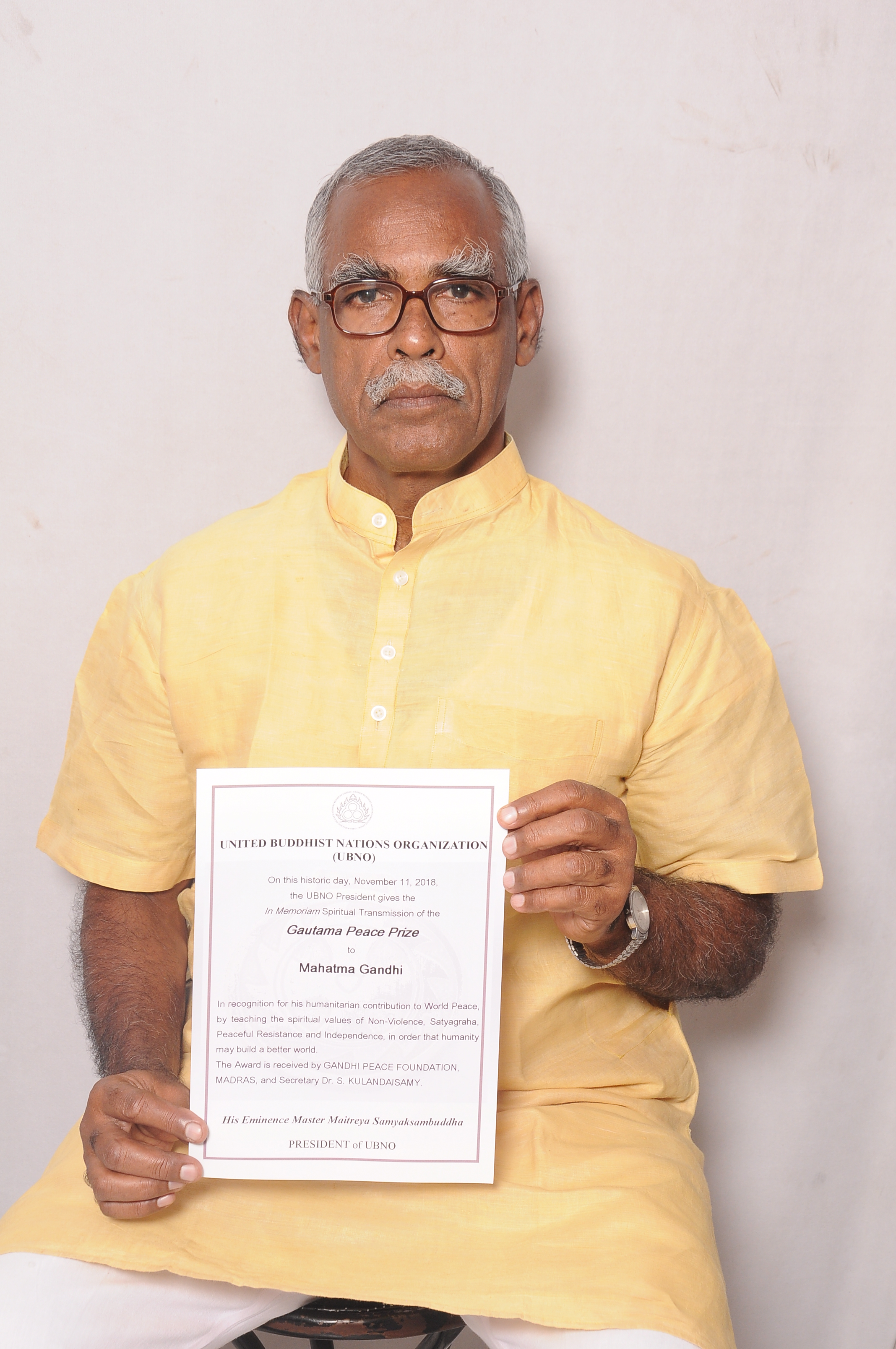
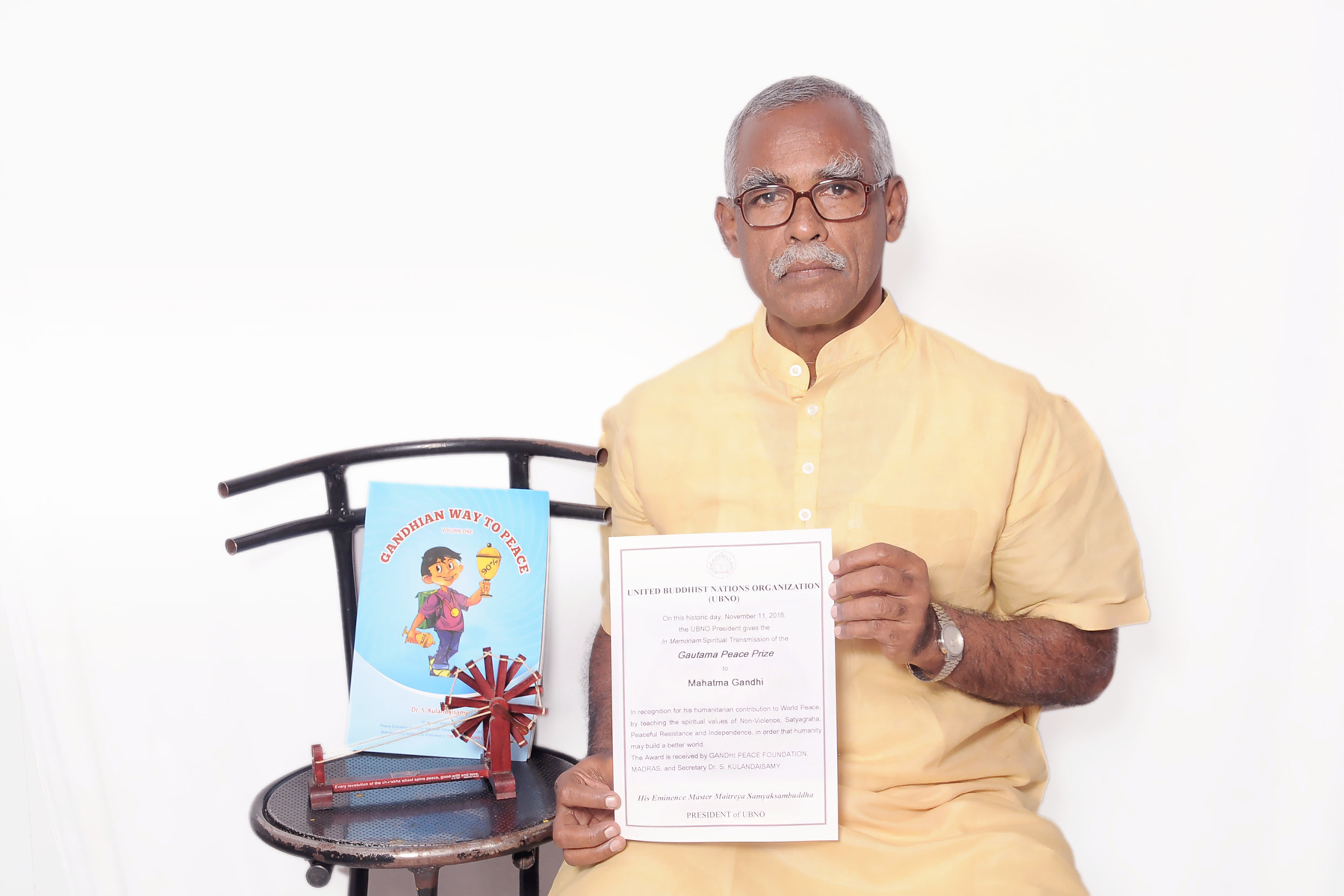
In November 2018, H.E. Master Maitreya Samyaksambuddha has performed the Spiritual Transmission In Memoriam of the GAUTAMA PEACE PRIZE to Mahatma Gandhi, for his contribution to World Peace, Non-violence, Independence and Satyagraha.
The Peace Award was received by Gandhi Peace Foundation, Madras, and its Secretary S.Kulandaisamy.
Letter from Gandhi Peace Foundation
MAHATMA GANDHI
Biography
Mohandas Karamchand Gandhi was an eminent freedom activist and an influential political leader who played a dominant role in India’s struggle for independence. Gandhi is known by different names, such as Mahatma (a great soul), Bapuji (endearment for father in Gujarati) and Father of the Nation. Every year, his birthday is celebrated as Gandhi Jayanti, a national holiday in India, and also observed as the International Day of Nonviolence. Mahatma Gandhi, as he is most commonly referred to, was instrumental in liberating India from the clutches of the British. With his unusual yet powerful political tools of Satyagraha and non-violence, he inspired several other political leaders all over the world including the likes of Nelson Mandela, Martin Luther King Jr and Aung San Suu Kyi. Gandhi, apart from helping India triumph in its fight for independence against the English, also led a simple and righteous life, for which he is often revered. Gandhi’s early life was pretty much ordinary, and he became a great man during the course of his life. This is one of the main reasons why Gandhi is followed by millions, for he proved that one can become a great soul during the course of one’s life, should they possess the will to do so.
M. K. Gandhi was born in the princely state of Porbandar, which is located in modern-day Gujarat. He was born into a Hindu merchant caste family to Karamchand Gandhi, diwan of Porbandar and his fourth wife, Putlibai. Gandhi’s mother belonged to an affluent Pranami Vaishnava family. As a child, Gandhi was a very naughty and mischievous kid. In fact, his sister Raliat had once revealed that hurting dogs by twisting their ears was among Maohandas’ favorite pastime. During the course of his childhood, Gandhi befriended Sheikh Mehtab, who was introduced to him by his older brother. Gandhi, who was raised by a vegetarian family, started eating meat. It is also said that a young Gandhi accompanied Sheikh to a brothel, but left the place after finding it uncomfortable. Gandhi, along with one of his relatives, also cultivated the habit of smoking after watching his uncle smoke. After smoking the leftover cigarettes, thrown away by his uncle, Gandhi started stealing copper coins from his servants in order to buy Indian cigarettes. When he could no longer steal, he even decided to commit suicide such was Gandhi’s addiction to cigarettes. At the age of fifteen, after stealing a bit of gold from his friend Sheikh’s armlet, Gandhi felt remorseful and confessed to his father about his stealing habit and vowed to him that he would never commit such mistakes again.
In his early years, Gandhi was deeply influenced by the stories of Shravana and Harishchandra that reflected the importance of truth. Through these stories and from his personal experiences, he realized that truth and love are among the supreme values. Mohandas married Kasturba Makhanji at the age of 13. Gandhi later went on to reveal that the marriage didn’t mean anything to him at that age and that he was happy and excited only about wearing new set of clothes. But then as days passed by, his feelings for her turned lustful, which he later confessed with regret in his autobiography. Gandhi had also confessed that he could no more concentrate in school because of his mind wavering towards his new and young wife.
After his family moved to Rajkot, a nine year old Gandhi was enrolled at a local school, where he studied the basics of arithmetic, history, geography and languages. When he was 11 years old, he attended a high school in Rajkot. He lost an academic year in between because of his wedding but later rejoined the school and eventually completed his schooling. He then dropped out of Samaldas College in Bhavnagar State after joining it in the year 1888. Later Gandhi was advised by a family friend Mavji Dave Joshiji to pursue law in London. Excited by the idea, Gandhi managed to convince his mother and wife by vowing before them that he would abstain from eating meat and from having sex in London. Supported by his brother, Gandhi left to London and attended the Inner Temple and practiced law. During his stay in London, Gandhi joined a Vegetarian Society and was soon introduced to Bhagavad Gita by some of his vegetarian friends. The contents of Bhagavad Gita would later have a massive influence on his life. He came back to India after being called to the bar by Inner Temple.
After returning to India, Gandhi struggled to find work as a lawyer. In 1893, Dada Abdullah, a merchant who owned a shipping business in South Africa asked if he would be interested to serve as his cousin’s lawyer in South Africa. Gandhi gladly accepted the offer and left to South Africa, which would serve as a turning point in his political career.
In South Africa, he faced racial discrimination directed towards blacks and Indians. He faced humiliation on many occasions but made up his mind to fight for his rights. This turned him into an activist and he took upon him many cases that would benefit the Indians and other minorities living in South Africa. Indians were not allowed to vote or walk on footpaths as those privileges were limited strictly to the Europeans. Gandhi questioned this unfair treatment and eventually managed to establish an organization named ‘Natal Indian Congress’ in 1894. After he came across an ancient Indian literature known as ‘Tirukkural’, which was originally written in Tamil and later translated into many languages, Gandhi was influenced by the idea of Satyagraha (devotion to the truth) and implemented non-violent protests around 1906. After spending 21 years in South Africa, where he fought for civil rights, he had transformed into a new person and he returned to India in 1915.
After his long stay in South Africa and his activism against the racist policy of the British, Gandhi had earned the reputation as a nationalist, theorist and organiser. Gopal Krishna Gokhale, a senior leader of the Indian National Congress, invited Gandhi to join India’s struggle for independence against the British Rule. Gokhale thoroughly guided Mohandas Karamchand Gandhi about the prevailing political situation in India and also the social issues of the time. He then joined the Indian National Congress and before taking over the leadership in 1920, headed many agitations which he named Satyagraha.
The Champaran agitation in 1917 was the first major success of Gandhi after his arrival in India. The peasants of the area were forced by the British landlords to grow Indigo, which was a cash crop, but its demand had been declining. To make the matters worse, they were forced to sell their crops to the planters at a fixed price. The farmers turned to Gandhiji for help. Pursuing a strategy of nonviolent agitation, Gandhi took the administration by surprise and was successful in getting concessions from the authorities. This campaign marked Gandhi’s arrival in India!
Farmers asked the British to relax the payment of taxes as Kheda was hit by floods in 1918. When the British failed to pay heed to the requests, Gandhi took the case of the farmers and led the protests. He instructed them to refrain from paying revenues no matter what. Later, the British gave in and accepted to relax the revenue collection and gave its word to Vallabhbhai Patel, who had represented the farmers.
Gandhi had agreed to support the British during their fight in World War I. But the British failed to grant independence post the war, as promised earlier, and as a result of this Khilafat Movement was launched. Gandhi realized that Hindus and Muslims must unite to fight the British and urged both the communities to show solidarity and unity. But his move was questioned by many Hindu leaders. Despite the opposition from many leaders, Gandhi managed to amass the support of Muslims. But as the Khilafat Movement ended abruptly, all his efforts evaporated into thin air.
Non-cooperation Movement was one of Gandhi’s most important movements against the British. Gandhi’s urged his fellow countrymen to stop co-operation with the British. He believed that the British succeeded in India only because of the co-operation of the Indians. He had cautioned the British not to pass the Rowlatt Act, but they did not pay any attention to his words and passed the Act. As announced, Gandhiji asked everyone to start civil disobedience against the British. The British began suppressing the civil disobedience movement by force and opened fire on a peaceful crowd in Delhi. The British asked Gandhiji to not enter Delhi which he defied as a result of which he was arrested and this further enraged people and they rioted. He urged people to show unity, non-violence and respect for human life. But the British responded aggressively to this and arrested many protesters.
On 13 April 1919, a British officer, Dyer, ordered his forces to open fire on a peaceful gathering, including women and children, in Amritsar’s Jallianwala Bagh. As a result of this, hundreds of innocent Hindu and Sikh civilians were killed. The incident is known as ‘Jallianwala Bagh Massacre’. But Gandhi criticized the protesters instead of blaming the English and asked Indians to use love while dealing with the hatred of British. He urged the Indians to refrain from all kinds of non-violence and went on fast-to-death to pressure Indians to stop their rioting.
The concept of non-cooperation became very popular and started spreading through the length and breadth of India. Gandhi extended this movement and focused on Swaraj. He urged people to stop using British goods. He also asked people to resign from government employment, quit studying in British institutions and stop practicing in law courts. However, the violent clash in Chauri Chaura town of Uttar Pradesh, in February 1922, forced Gandhiji to call-off the movement all of a sudden. Gandhi was arrested on 10th March 1922 and was tried for sedition. He was sentenced to six years imprisonment, but served only two years in prison.
During the period of 1920s, Mahatma Gandhi concentrated on resolving the wedge between the Swaraj Party and the Indian National Congress. In 1927, British had appointed Sir John Simon as the head of a new constitutional reform commission, popularly known as ‘Simon Commission’. There was not even a single Indian in the commission. Agitated by this, Gandhi passed a resolution at the Calcutta Congress in December 1928, calling on the British government to grant India dominion status. In case of non-compliance with this demand, the British were to face a new campaign of non-violence, having its goal as complete independence for the country. The resolution was rejected by the British. The flag of India was unfurled by the Indian national Congress on 31st December 1929 at its Lahore session. January 26, 1930 was celebrated as the Independence Day of India.
But the British failed to recognize it and soon they levied a tax on salt and Salt Satyagraha was launched in March 1930, as an opposition to this move. Gandhi started the Dandi March with his followers in March, going from Ahmedabad to Dandi on foot. The protest was successful and resulted in the Gandhi-Irwin Pact in March 1931.
Post the Gandhi-Irwin Pact, Gandhi was invited to round table conferences by the British. While Gandhi pressed for the Indian independence, British questioned Gandhi’s motives and asked him not to speak for the entire nation. They invited many religious leaders and B. R. Ambedkar to represent the untouchables. The British promised many rights to various religious groups as well as the untouchables. Fearing this move would divide India further, Gandhi protested against this by fasting. After learning about the true intentions of the British during the second conference, he came up with another Satyagraha, for which he was once again arrested.
As the World War II progressed, Mahatma Gandhi intensified his protests for the complete independence of India. He drafted a resolution calling for the British to Quit India. The ‘Quit India Movement’ or the ‘Bharat Chhodo Andolan’ was the most aggressive movement launched by the Indian national Congrees under the leadership of Mahatma Gandhi. Gandhi was arrested on 9th August 1942 and was held for two years in the Aga Khan Palace in Pune, where he lost his secretary, Mahadev Desai and his wife, Kasturba. The Quit India Movement came to an end by the end of 1943, when the British gave hints that complete power would be transferred to the people of India. Gandhi called off the movement which resulted in the release of 100,000 political prisoners.
The independence cum partition proposal offered by the British Cabinet Mission in 1946 was accepted by the Congress, despite being advised otherwise by Mahatma Gandhi. Sardar Patel convinced Gandhi that it was the only way to avoid civil war and he reluctantly gave his consent. After India’s independence, Gandhi focused on peace and unity of Hindus and Muslims. He launched his last fast-unto-death in Delhi, and asked people to stop communal violence and emphasized that the payment of Rs. 55 crores, as per the Partition Council agreement, be made to Pakistan. Ultimately, all political leaders conceded to his wishes and he broke his fast.
The inspiring life of Mahatma Gandhi came to an end on 30th January 1948, when he was shot by a fanatic, Nathuram Godse, at point-blank range. Nathuram was a Hindu radical, who held Gandhi responsible for weakening India by ensuring the partition payment to Pakistan. Godse and his co-conspirator, Narayan Apte, were later tried and convicted. They were executed on 15th November 1949.
Mahatma Gandhi proposed the acceptance and practice of truth, non-violence, vegetarianism, Brahmacharya (celibacy), simplicity and faith in God. Though he would be remembered forever as the man who fought for Indian independence, his greatest legacies are the tools he used in his fight against the British. These methods inspired several other world leaders in their struggle against injustice. His statues are installed all over the world and he is considered the most prominent personality in Indian history.
The word Mahatma is often mistaken in the West as Gandhi’s first name. His extraordinary life inspired innumerable works of art in the field of literature, art and showbiz. Many movies and documentaries have been made on the life of the Mahatma. Post the Independence, Gandhi’s image became the mainstay of Indian paper currency.
The UNITED BUDDHIST NATIONS ORGANIZATION is the legislative power of the Maitriyana Buddhist Community, endorsing the following projects:
Universal Declaration of Spiritual Rights
Universal Declaration of Ecological Rights
Universal Declaration on the Right to World Peace
Universal Declaration on the Rights of Buddhist Peoples and Spiritual Communities
Universal Declaration on the Rights of Non-Human Beings
Universal Declaration on the Right to Interspiritual and Interfaith Harmony
UNIVERSAL DECLARATION ON THE RESPONSIBILITY TO SAVE THE WORLD
Declaration of Independence of the United Buddhist Nations Organization
Universal Declaration on Buddhism as Cultural Heritage of Humanity
Buddhist Manifesto to the Nations of the World
Buddhist Statement against Terrorism and Religious Manipulation
Buddhist Statement against Tao Zen Dojo
The United Buddhist Nations Organization (UBNO) is the legislative power of the MAITRIYANA BUDDHIST COMMUNITY, which is member of the INTERNATIONAL PEACE BUREAU.
 Maitriyana Buddhist Community